Field note 02 · Pacing
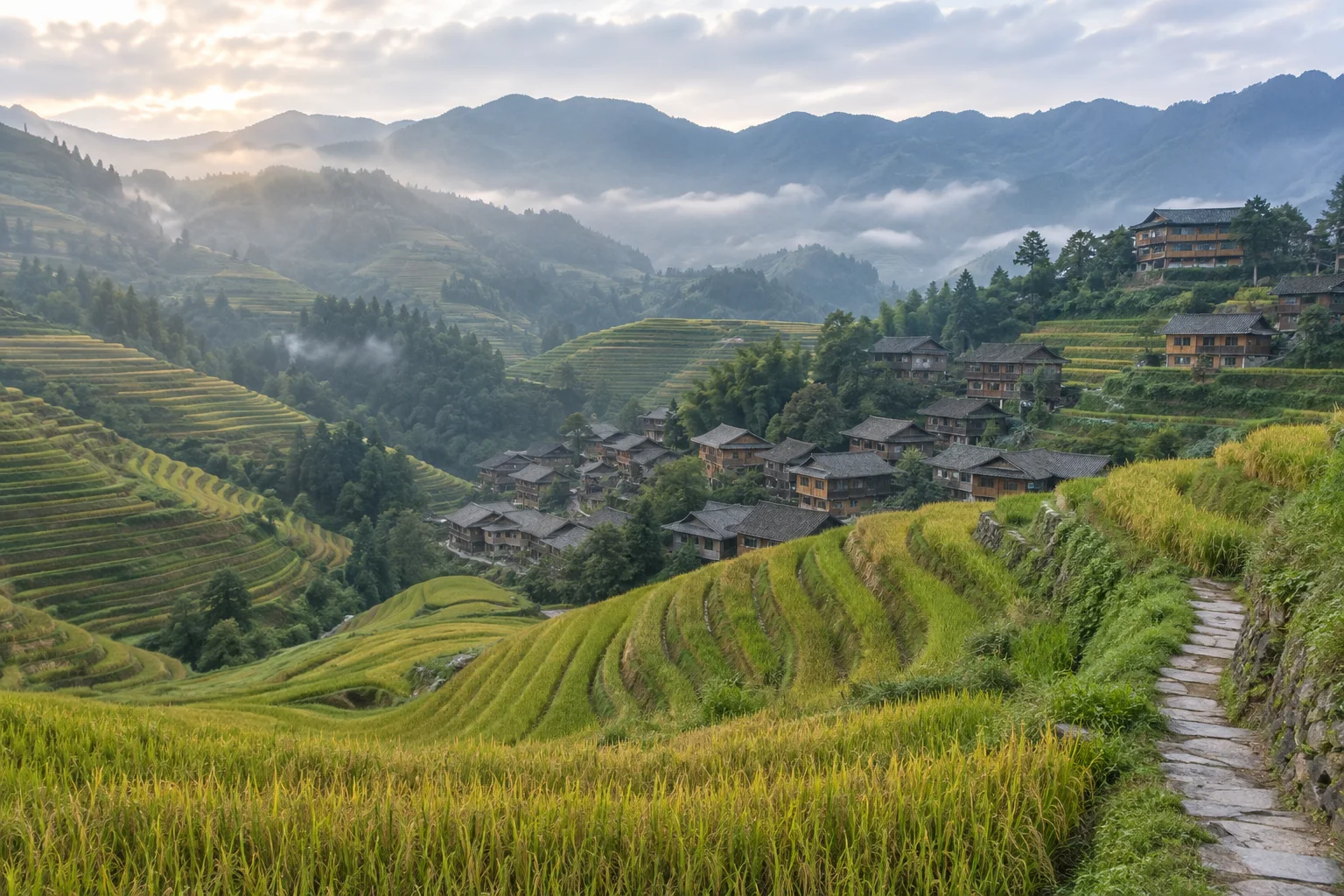
Why Longji deserves the night
The landscape changes when the paths empty. An overnight also turns a rushed out-and-back into a clean north-to-south route.
Journey map · all visited places
The complete Guilin, Longji and Yangshuo sequence
All route stops are shown together so the north-to-south movement is visible at once. Lines describe the planned travel sequence rather than live road or walking directions.
- days
- 5
- mapped places
- 25
- overnight bases
- 3
01 · Route pressure
The problem with going up and back in one day
A same-day return turns Longji into a race between road time and viewpoint time. The transfer from Guilin is long enough that lunch, the climb and the descent all begin to answer the clock rather than the landscape.
It also creates unnecessary backtracking. If the route is already continuing south toward the Li River and Yangshuo, sleeping in the terraces creates a clean line through Guangxi instead of sending the traveler back to the same city hotel for one short night.
02 · After the day buses
Longji becomes quieter, not empty
In late afternoon the terraces stop behaving like a single panorama. Smoke rises from kitchens, water moves through channels and the timber village becomes the foreground rather than a frame around a photograph.
Staying in Ping’an means the final walk can be short and unhurried. Dinner at the lodge, a darker sky and the sound of the village settling are modest experiences, but together they make the mountain feel inhabited.
03 · The second half
Morning completes the terrace story
The next morning is not a repeat of the previous viewpoint. Low cloud, clear sun or rain can redraw every contour, and the first paths are shared with residents rather than tour groups.
A simple breakfast and one final walk are enough. The point is not to cover more trails; it is to leave after seeing how light, weather and village life change the same landscape across two parts of a day.
04 · Onward movement
Continue south instead of retracing the route
From Longji, the journey returns to Guilin only as a transfer point before the Li River carries it toward Yangshuo. The sequence becomes mountain village, river arrival and countryside stay—three distinct chapters with no duplicated hotel night.
That cleaner movement is the practical reason the overnight works. The emotional reason is simpler: the terraces are allowed to be a place where the traveler wakes up, not a view collected between two long drives.
Continue from story to itinerary