Field note 03 · Route design
Follow the river instead of collecting viewpoints
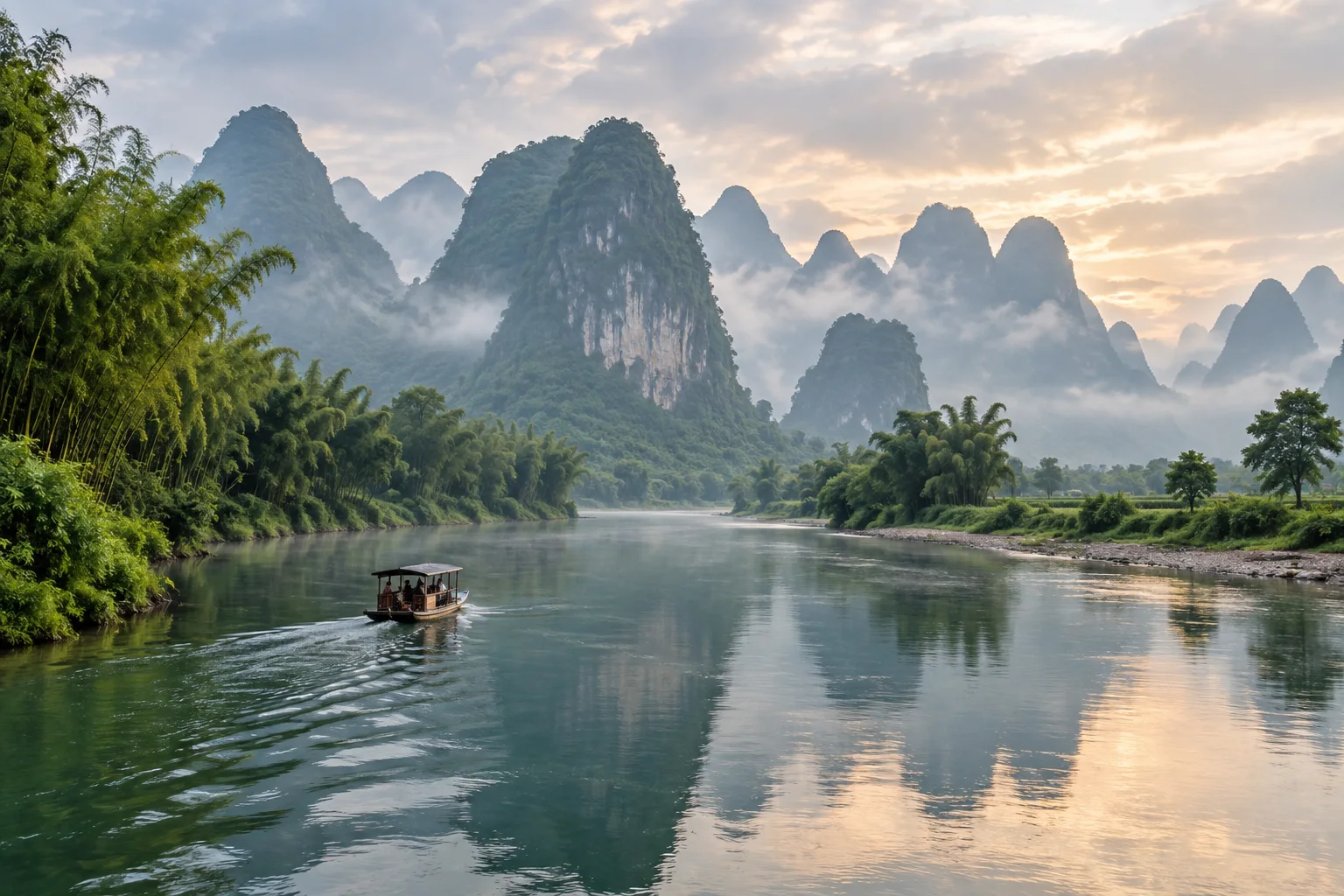
A boat, a bicycle and a short raft reveal Guangxi at three speeds without turning the itinerary into an activity list.
Journey map · all visited places
See every river-country stop in one view
The map marks the full five-day route, including stays and transport points. It is an editorial overview, not a claim of navigation accuracy.
- days
- 5
- mapped places
- 25
- overnight bases
- 3
01 · Route logic
One landscape, three useful speeds
The main Li River cruise gives scale: hours of water, villages and peaks unfolding without the traveler constantly deciding where to stop. Cycling adds ground-level texture, while a short raft on the Yulong River slows the final section to the pace of reflections and small bridges.
None of these modes needs to claim the whole trip. Their value comes from contrast. Together they prevent Guangxi from becoming a chain of lookouts reached by car.
02 · Arrival
Let the Li River introduce Yangshuo
Arriving by boat makes the geography legible before the town appears. Guilin recedes, the valley narrows and the peaks begin to repeat in changing combinations. The travel time is also the experience, not a gap to be minimized.
Once ashore, the route avoids treating busy West Street as the conclusion. A transfer into the Yulong River countryside keeps the landscape present and turns Yangshuo into a base for the next day rather than a crowded terminal.
03 · Ground level
Use the bicycle to connect ordinary details
On a bicycle, the peaks stop being a distant wall. The route moves past fields, school gates, orchards and small crossings, with enough flexibility to pause when the weather or a village lane feels more interesting than the planned stop.
The best loop is intentionally short. It leaves time for lunch, a rest during the warmest part of the day and an unhurried final section beside the Yulong River.
04 · The wider journey
Keep the river connected to the mountain chapter
Longji and Yangshuo are often presented as separate excursions from Guilin. In one directional route, they explain more together: the terraces show how people have shaped steep land, while the river shows how movement has followed the valleys below.
The result is not a list of Guangxi highlights. It is a journey with a visible geographic argument, moving from cultivated mountain contours to water-shaped karst country.
Continue from story to itinerary